
Bangkok’s floodwater is receding in some districts, but recovery has a long to-do list
5 October 2026


IceCube catches traces of elusive neutrinos, opening another way to study the distant universe.
By Steve Carsley 7 October 2026
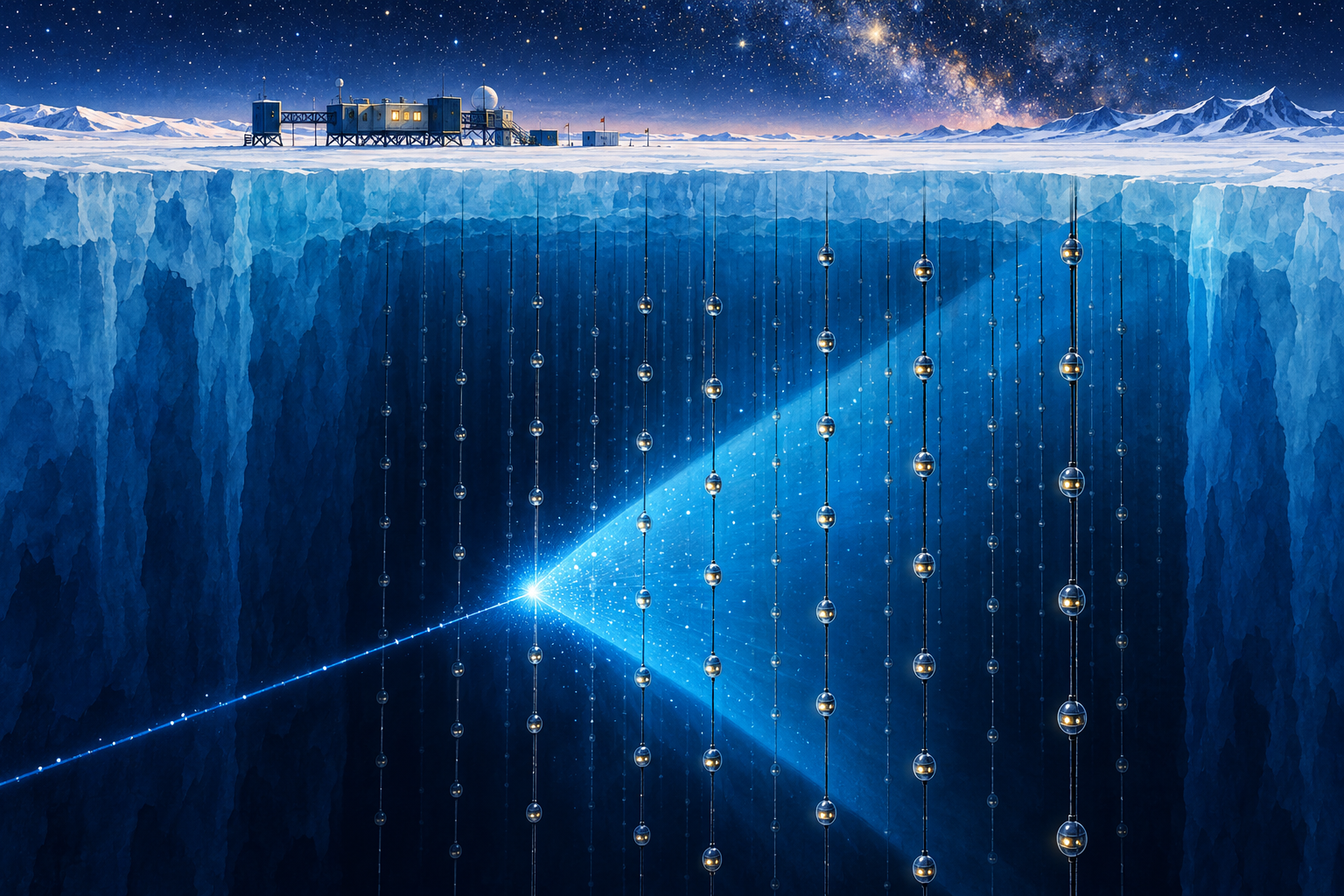
Most people looking for clues about space would point a telescope at the sky. Francis Halzen helped build one that looks deep into Antarctic ice. That unusual idea has now earned him the 2026 Nobel Prize in Physics.
The award was announced on October 6 for his work on the IceCube Neutrino Observatory and the discovery of high-energy neutrinos arriving from beyond Earth. Halzen is based at the University of Wisconsin–Madison in the United States.
The Royal Swedish Academy’s announcement, reproduced by Fermilab, explains the central idea: use an enormous volume of South Pole ice, fitted with light sensors, to detect particles that are exceptionally difficult to catch.
Neutrinos can pass through matter with very little interaction. They cross the Earth and our bodies without us noticing. Very occasionally, one interacts with an atomic nucleus, creating a trace that the right equipment can detect.
That is why IceCube needs so much ice. Its detector covers a cubic kilometre. Instead of waiting for a particle to hit a small instrument on a desk, scientists watch a huge natural detection space for rare signals.
The nickname sounds spooky, but there is nothing supernatural about it. These are physical particles. Their reluctance to interact is both the reason they are hard to measure and part of what makes them interesting as messengers from space.
Nature’s coverage of the award describes Halzen’s role in founding the observatory and detecting high-energy neutrinos from the distant universe. The achievement adds another way to investigate cosmic events alongside observations made using light.
A Nobel announcement names a person, but building and operating an observatory takes far more people. IceCube’s announcement describes a collaboration of 450 scientists at 58 institutions across 14 countries.
The team discovered astrophysical neutrinos in 2013, when their sources were still unknown. It has since reported evidence linking neutrino emission to particular galaxies, and in 2023 announced neutrinos from our own Milky Way.
Those steps show why a scientific breakthrough is rarely the final answer. Detecting something opens the next question: where did it come from, and what can it tell us? Each better measurement can give researchers a more useful piece of the puzzle.
The project is still developing. IceCube says an upgrade installed in 2025–2026 is intended to improve calibration and extend its scientific capabilities, with its first science data expected later this year.
For students wondering what an ambitious science idea looks like, this is a memorable example. Sometimes the route to understanding the sky begins by finding a clever use for the ground beneath your feet.
Similar stories