
A telescope buried in Antarctic ice helps Francis Halzen win the physics Nobel
7 October 2026


Their discoveries explain how tiny differences between mirror-image molecules can grow into a strong preference.
By Steve Carsley 8 October 2026
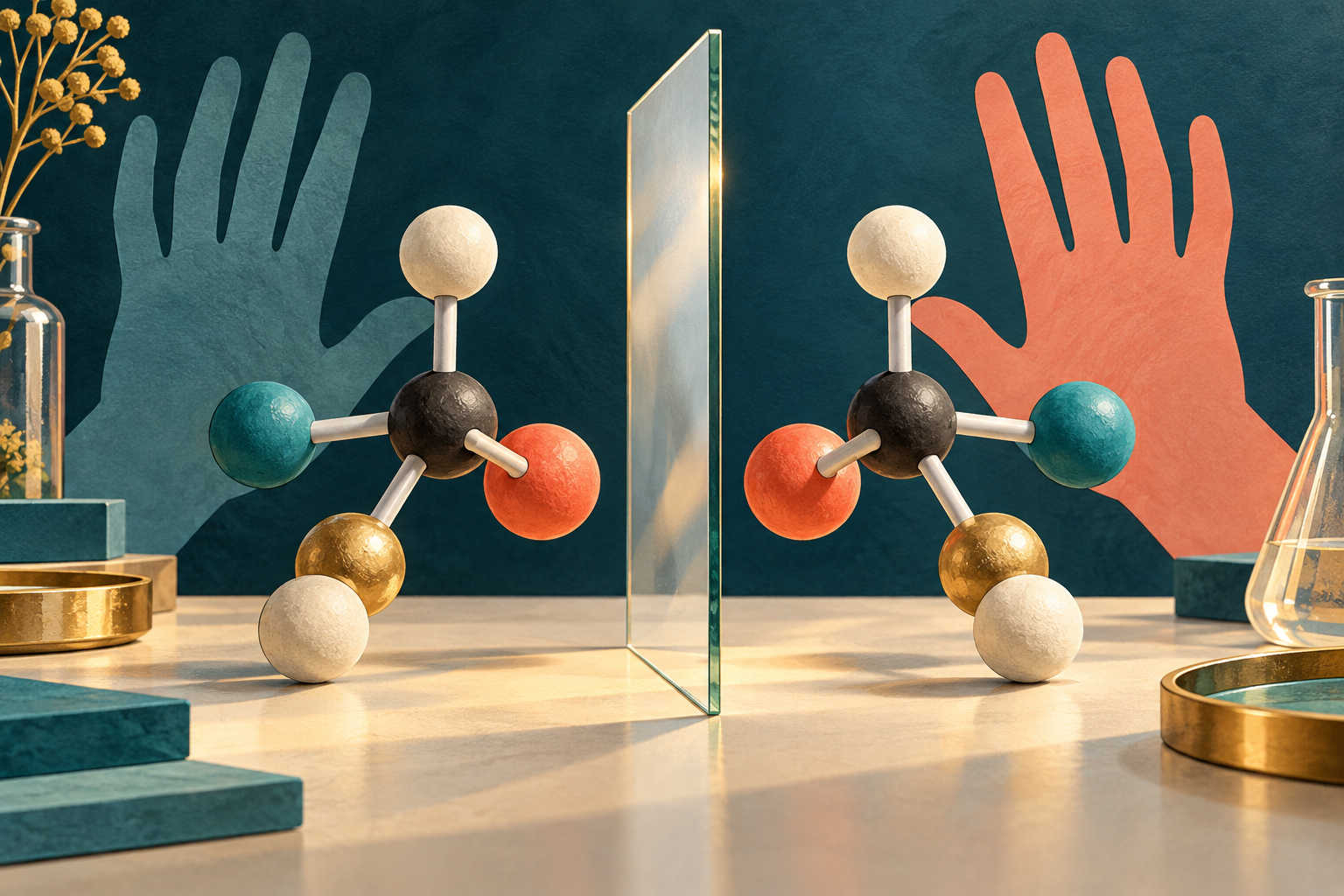
Hold your hands in front of you. They look like matching versions of the same thing, yet a left hand will not fit a right-handed glove in quite the same way. Some molecules have a similar problem.
Henri B. Kagan and Kenso Soai won the 2026 Nobel Prize in Chemistry on October 7 for discoveries that helped explain and control this molecular handedness. Their work showed how chemical reactions can strongly favour one mirror-image form over the other.
French researcher Kagan is 95, while Japan’s Soai is 76, Reuters reported. The prize recognises research with deep importance for understanding chemistry and designing reactions that produce the molecular form scientists want.
Mirror-image molecules can contain the same atoms arranged in ways that cannot be perfectly placed on top of each other. Chemists call this property chirality. The word may look intimidating, but the hands comparison gets you most of the way to the basic idea.
Living systems can respond differently to those forms. That makes control over handedness important when chemists work on medicines, flavours and other substances. A molecular formula alone does not always tell the whole story; the arrangement matters too.
The American Chemical Society’s explanation describes Kagan’s 1986 finding: a reaction could produce a stronger preference for one molecular form than chemists expected from the mixture used to prepare its catalyst. A small imbalance did not have to stay small.
Soai took the idea further through autocatalysis. In this process, a product helps catalyse the reaction that makes more of that product. His 1995 work showed how repeated rounds could greatly amplify a tiny initial preference for one mirror-image form.
The discoveries help researchers investigate how strongly one-sided molecular mixtures can emerge. They do not, by themselves, provide a complete account of how life began. Instead, they give scientists a way to study an important part of that much larger question.
Kagan’s research home, the Institute of Molecular Chemistry and Materials of Orsay, celebrated the award and his long contribution to the field. It said he had taught organic chemistry on the Orsay campus since 1967 and helped found the institute in 1980.
The recognition also carries a very ordinary human detail. Soai told the Nobel press conference that he had been grocery shopping when news of the award reached him, according to Reuters. Quite an upgrade from a normal shopping trip.
For anyone who remembers chemistry as a wall of formulas, this prize offers another view of the subject. The puzzle is about shape, fit and how a tiny advantage can grow. Understanding those details can change what scientists are able to make.
Similar stories